
The telecom industry’s shift from 4G’s session-based Online Charging System (OCS) to 5G’s event-driven architecture demands a fundamental rethink of how charging systems integrate with core networks. For operators using Oracle Communications Network Charging and Control (OCNCC), this transition presents both a challenge and an opportunity: How can a traditionally session-oriented platform like OCNCC evolve to support the agility and real-time demands of 5G?
Over the recent weeks, I’ve been exploring this question, not just theoretically, but by building a proof-of-concept API layer that abstracts OCNCC’s proprietary Escher protocol into a modern, RESTful interface. The goal? To transform OCNCC from a session-based OCS into an event-based powerhouse, capable of seamless integration with 5G control planes, MVNO setups, and cloud-native architectures.
The Problem: Session-Based OCS in a 4G World
In 4G networks, OCS typically operates in a session-based model:
- Charging decisions are tied to active sessions (e.g., data, voice, or messaging).
- The Escher protocol (Oracle’s proprietary interface for OCNCC) handles real-time interactions between the Billing Engine (VWS) and other network elements.
- Limitations:
- Tight coupling with session state makes it difficult to scale or integrate with modern, stateless systems.
- Direct protocol handling (e.g., via SDKs) is complex, error-prone, and lacks flexibility for dynamic use cases like 5G’s event-driven charging.
- Limited observability into protocol-level interactions, making troubleshooting and optimisation difficult.
For operators looking to modernise their charging infrastructure, these constraints can feel like a roadblock—especially when aiming to adopt 5G’s service-based architecture (SBA), where event-driven interactions (e.g., HTTP/2, JSON) replace traditional session-based protocols.
The Solution: Decoding Escher to Build an Event-Based API Layer
Step 1: Gaining Visibility with a Wireshark Dissector
The first hurdle is understanding Escher’s message flows. Without visibility into the protocol, it’s nearly impossible to design a robust abstraction layer. To solve this, I developed:
- A custom Wireshark dissector for Escher, enabling deep packet inspection of OCNCC interactions.
- A Javascript PCAP-to-JSON decoder to convert captured network traffic into structured, analysable data.
Result: A blueprint of Escher message sequences, including:
- Session establishment/teardown flows.
- Balance deduction and reservation logic.
- Error handling and retry mechanisms.
This step was critical, in order to reverse-engineer the protocol’s behaviour and identify which operations could (and should) be exposed via a RESTful API.
Step 2: Abstracting Escher into a RESTful API
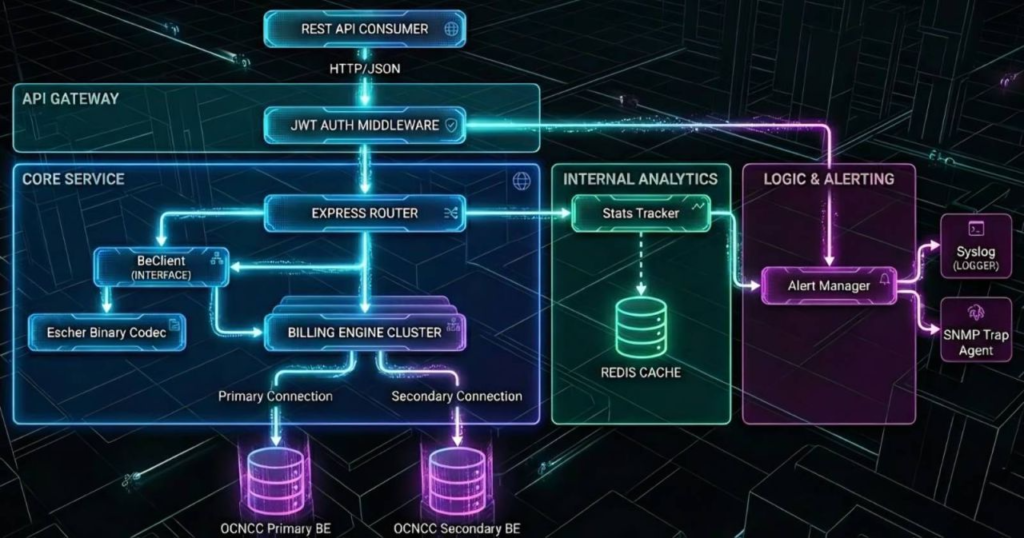
With the decoded flows in hand, we can, and have built a cloud supported JavaScript-based API server that:
- Interfaces directly with OCNCC’s billing engines (VWS) via Escher.
- Exposes every key operation as a RESTful endpoint, effectively decoupling the protocol from the application layer.
Key Features of the API Layer:
| Feature | Benefit |
|---|---|
| JWT-based authentication | Secure access with token-based client authentication. |
| Client-level access control | Restrict endpoints per integration (e.g., MVNOs, 5G core functions). |
| Redis caching | Improve performance for high-frequency operations (e.g., balance checks). |
| Structured interaction model | Repeatable, predictable workflows for charging operations. |
| Subscriber data retrieval | Fetch subscriber profiles directly from OCNCC’s database. |
| Profile block management | Basic subscriber profile updates (e.g., barring/unbarring). |
Example Endpoints:
POST /api/sessions/{sessionId}/charge      # Deduct balance for a session event
GET  /api/subscribers/{msisdn}/balance     # Retrieve subscriber balance
PUT  /api/subscribers/{msisdn}/profile     # Update subscriber profile
GET  /api/statistics                       # Observability metrics (e.g., QPS, latency)
Step 3: Enabling Event-Based OCS for 5G
By exposing OCNCC’s charging logic via RESTful APIs, the system can now:
- Integrate with 5G’s Service-Based Architecture (SBA):
- Replace session-based Escher interactions with event-driven HTTP/2 calls (e.g., from the 5G PCF or CHF).
- Support stateless charging decisions, aligning with 5G’s microservices approach.
- Support MVNO and Multi-Tenant Scenarios:
- Client-level access control allows different MVNOs or partners to interact with only their permitted endpoints.
- JWT tokens ensure secure, auditable access.
- Improve Observability and Debugging:
- Built-in statistics and logging provide visibility into charging operations, a major improvement over opaque protocol interactions.
- Simplify Monthly Bundle Resets:
- Previously required custom SDK scripts; now handled via a single API call (e.g.,
POST /api/bundles/reset).
- Previously required custom SDK scripts; now handled via a single API call (e.g.,
Why This Matters for OCNCC Operators
1. Future-Proofing for 5G
5G’s event-based charging requires systems that can:
- Handle high-volume, low-latency interactions (e.g., for IoT or URLLC use cases).
- Support dynamic policy control (e.g., real-time QOS adjustments).
- Integrate with cloud-native functions (e.g., Kubernetes-based NFs).
An API layer abstracting OCNCC’s Escher protocol bridges the gap between legacy OCS and modern 5G architectures.
2. Reducing Integration Complexity
Traditional OCNCC integrations often require:
- Custom SDK development for each use case.
- Deep protocol knowledge (Escher is proprietary and poorly documented).
- Tight coupling with session state.
With a RESTful API:
- Developers interact with familiar HTTP endpoints instead of raw Escher messages.
- New services can be onboarded faster (e.g., a new MVNO or 5G network slice).
3. Unlocking New Use Cases
Potential applications include:
- Real-time charging for 5G slicing: Dynamically adjust charging based on slice SLA.
- Convergent charging: Unify prepaid/postpaid logic across 4G/5G.
- AI-driven policy control: Use API hooks to inject ML-based charging decisions.
The Road Ahead: From Proof-of-Concept to Production
While the current implementation is a personal proof-of-concept, the framework is already functional for several key OCS operations. To move this toward a production-ready solution, the next steps include:
- Extending Endpoint Coverage:
- Add support for all critical Escher operations (e.g., session termination, refunds, shared balance groups).
- Implement idempotency keys for retry safety.
- Enhancing Security:
- Rate limiting to prevent abuse.
- Field-level encryption for sensitive subscriber data.
- Audit logs for compliance (e.g., GDPR).
- Performance Optimisdation:
- Connection pooling for Escher protocol sessions.
- Asynchronous processing for non-blocking operations.
- QA and Validation:
- Load testing to ensure scalability (e.g., 10K+ TPS).
- Failure mode testing (e.g., billing engine timeouts).
- Documentation and SDKs:
- OpenAPI/Swagger specs for easy integration.
- Client libraries (e.g., Python, Java) to simplify adoption.
A Call to Collaborate
This project started as a way to scratch an itch, gaining visibility into OCNCC’s Escher protocol, but it’s evolved into something with far broader potential. By abstracting OCNCC’s charging logic into a modern API, we can:
- Modernise legacy OCS platforms without rip-and-replace.
- Enable 5G-ready charging architectures today.
- Open new integration possibilities for MVNOs, IoT, and cloud-native networks.
If you’re an OCNCC operator or telecom architect exploring ways to transition from session-based to event-based charging, I’d love to discuss how this approach could work for your use case. Whether it’s a pilot project, a specific integration challenge, or just a brainstorming session, let’s connect and explore the possibilities.