
Introduction
Artificial Intelligence has fundamentally changed the way software can be developed. Tasks that once took days can now be completed in hours, repetitive boilerplate can be generated almost instantly, documentation can be drafted automatically, and developers have an ever-present assistant capable of accelerating almost every aspect of software engineering.
For startups and established businesses alike, this is transformative.
However, one lesson has become increasingly clear as AI-assisted development matures:
AI accelerates development: it does not replace software engineering discipline.
If anything, the faster code can be written, the more important it becomes to maintain a structured, iterative development process.
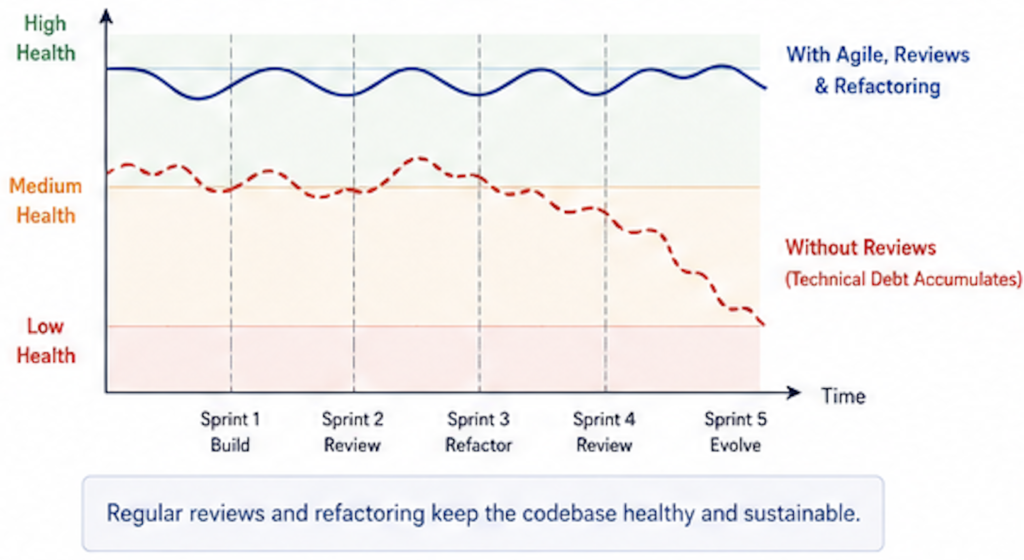
Speed Can Create Technical Debt
One of AI’s greatest strengths is its ability to generate working code quickly.
Given a well-defined prompt, modern AI tools can produce complete components, APIs, database migrations, unit tests and documentation in minutes.
The challenge is that these outputs are often created in isolation.
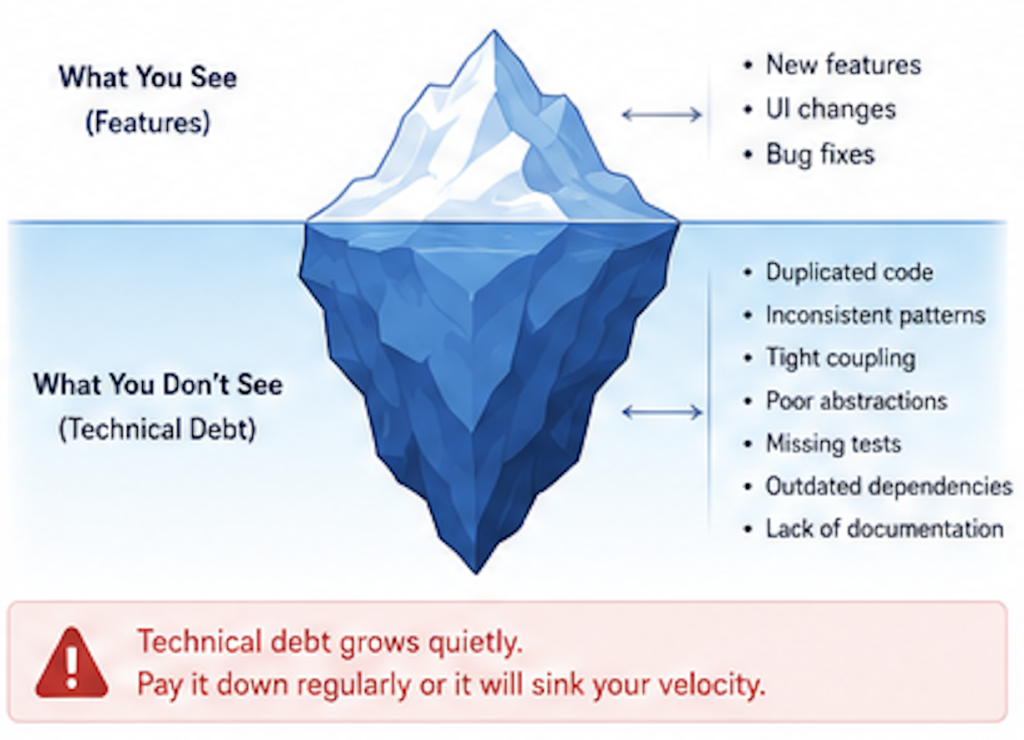
Without regular architectural oversight, an application can begin to accumulate:
- duplicated business logic
- inconsistent coding styles
- multiple approaches solving the same problem
- diverging architectural patterns
- unnecessary abstractions
- hidden technical debt
Each individual piece of code may be perfectly valid, yet collectively the application becomes increasingly difficult to understand and maintain.
This isn’t a failure of AI.
It’s a consequence of accelerating development without equally accelerating governance.
The Importance of Product-Led Development
AI performs best when solving clearly defined problems.
That places greater importance on maintaining a living product roadmap.
Rather than asking AI to “build features”, successful teams define:
- the business problem
- user journeys
- acceptance criteria
- architectural constraints
- non-functional requirements
- future extensibility
Clear product requirements allow both developers and AI tools to evolve the platform intentionally instead of reactively.
As a product matures, every new capability should strengthen the core platform rather than simply add another layer on top.
The goal is not simply to ship features, it is to build a platform that remains maintainable after hundreds of features have been delivered.
Agile Is More Relevant Than Ever
Traditional Agile methodologies were designed to embrace change through short feedback cycles.
That philosophy becomes even more valuable when AI dramatically increases development velocity.
Short development sprints allow teams to regularly ask:
- Does this still align with the roadmap?
- Is there duplication emerging?
- Are architectural principles being followed?
- Can existing functionality be reused?
- Has complexity increased unnecessarily?
The objective is no longer simply to deliver functionality every sprint.
Each sprint should also improve the quality of the underlying platform.
Code Reviews Become Architectural Reviews
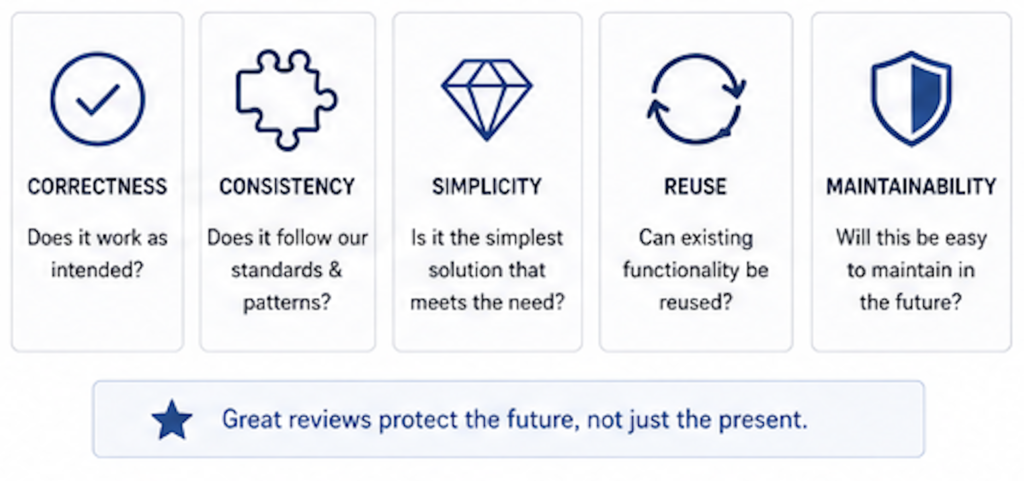
Historically, code reviews focused on correctness.
Today they must also focus on consistency.
Regular reviews should consider questions such as:
- Does this follow existing design patterns?
- Has similar functionality already been implemented elsewhere?
- Can common logic be extracted into reusable services?
- Are naming conventions still consistent?
- Is this introducing unnecessary coupling?
- Does it remain easy for future developers, and future AI assistants, to understand?
The best code review is often less about finding bugs and more about protecting the long-term health of the application.
Refactoring Should Be Planned
One misconception about modern software development is that refactoring is something that happens “when time allows.”
In reality, refactoring should be planned work.
Every few sprints it is healthy to pause feature development and focus on improving the foundation.
Typical activities include:
- consolidating duplicate services
- simplifying APIs
- improving database design
- extracting reusable components
- reorganising project structure
- improving documentation
- increasing automated test coverage
Ironically, AI makes this work significantly easier than it was just a few years ago.
Large-scale refactoring tasks that once carried considerable risk can now be completed much more confidently with AI assistance, provided they are reviewed by experienced engineers.
Product Evolution Requires Continuous Restructuring
No product roadmap remains static.
Customer feedback changes priorities.
Markets evolve.
New integrations appear.
Business models adapt.
The architecture must evolve alongside them.
Rather than treating the codebase as something that simply grows larger, successful teams periodically reshape it to reflect the current direction of the product.
This continuous evolution keeps complexity under control and ensures the platform remains flexible enough to support future growth.
Why Waterfall Falls Short
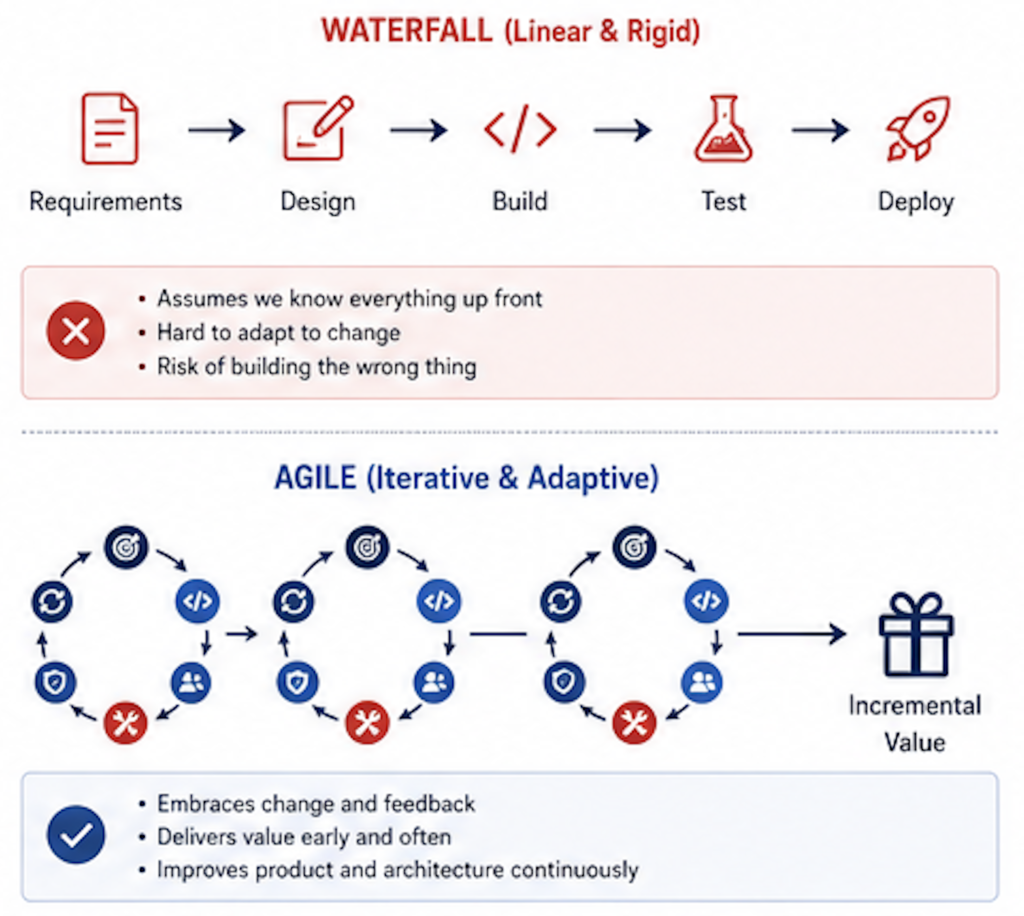
Traditional waterfall development assumes that requirements can be fully defined up front before implementation begins.
Modern AI-assisted development exposes the limitations of this approach even more clearly.
When development becomes dramatically faster, the ability to respond to changing requirements becomes the competitive advantage.
Large upfront designs often become outdated before implementation is complete.
By contrast, an iterative approach allows teams to continuously refine both the product and the architecture as new information emerges.
Rather than following a linear path:
Design → Build → Test → Release
AI-supported development is better viewed as a continuous cycle:
Define → Build → Review → Refactor → Validate → Repeat
Each cycle strengthens not only the functionality but also the quality of the platform itself.
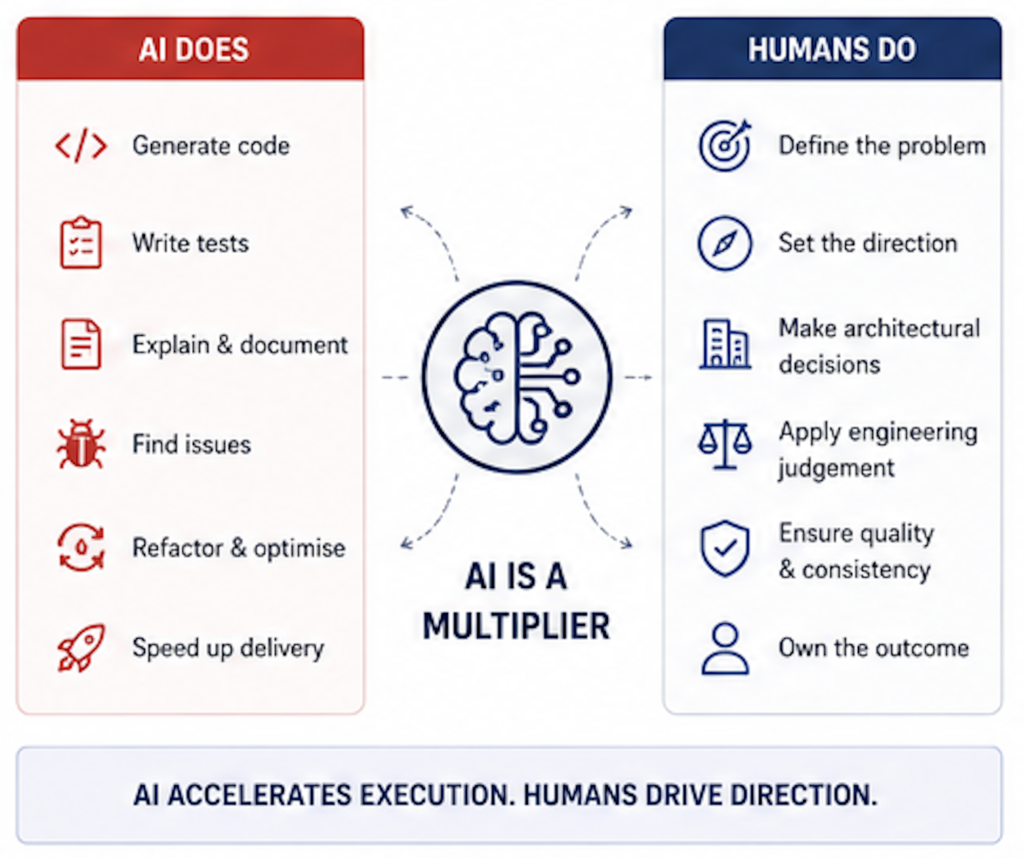
AI Is a Multiplier, Not a Replacement
AI has become an exceptional engineering assistant.
It can generate code, identify bugs, explain unfamiliar frameworks, write documentation, produce tests and accelerate delivery at a pace that would have seemed impossible only a few years ago.
What it cannot replace is thoughtful software architecture.
It cannot independently decide the long-term direction of a product.
It cannot own engineering standards.
It cannot determine when simplicity is preferable to cleverness.
Those remain human responsibilities.
The most successful development teams are therefore not replacing software engineering with AI, they are combining AI with disciplined engineering practices.
Final Thoughts
The future of software development is not AI versus Agile.
It is AI powered by Agile.
Rapid iteration, clearly defined product requirements, continuous architectural review and regular refactoring are no longer optional engineering practices, they are essential disciplines for maintaining high-quality software in an era where code can be generated faster than ever before.
The lesson many teams are discovering is simple: the speed of development should never outpace the quality of the architecture.
AI allows us to build faster.
Agile ensures we build the right thing.
Regular reviews ensure we build it well.
Together, they create software that is not only delivered quickly but is also robust, maintainable and ready to evolve as the product grows.